How thunderstorms form, and how TrekWeather reads the forecast setup.
Lightning Potential looks for the forecast ingredients behind thunderstorms: storm energy, unstable air, the atmospheric cap, storm-type precipitation, and a second-source thunder check from the National Weather Service.
Want the short version? Warm, moist air rises hard, builds a tall cloud, and the ice and water inside separate charge until lightning discharges.
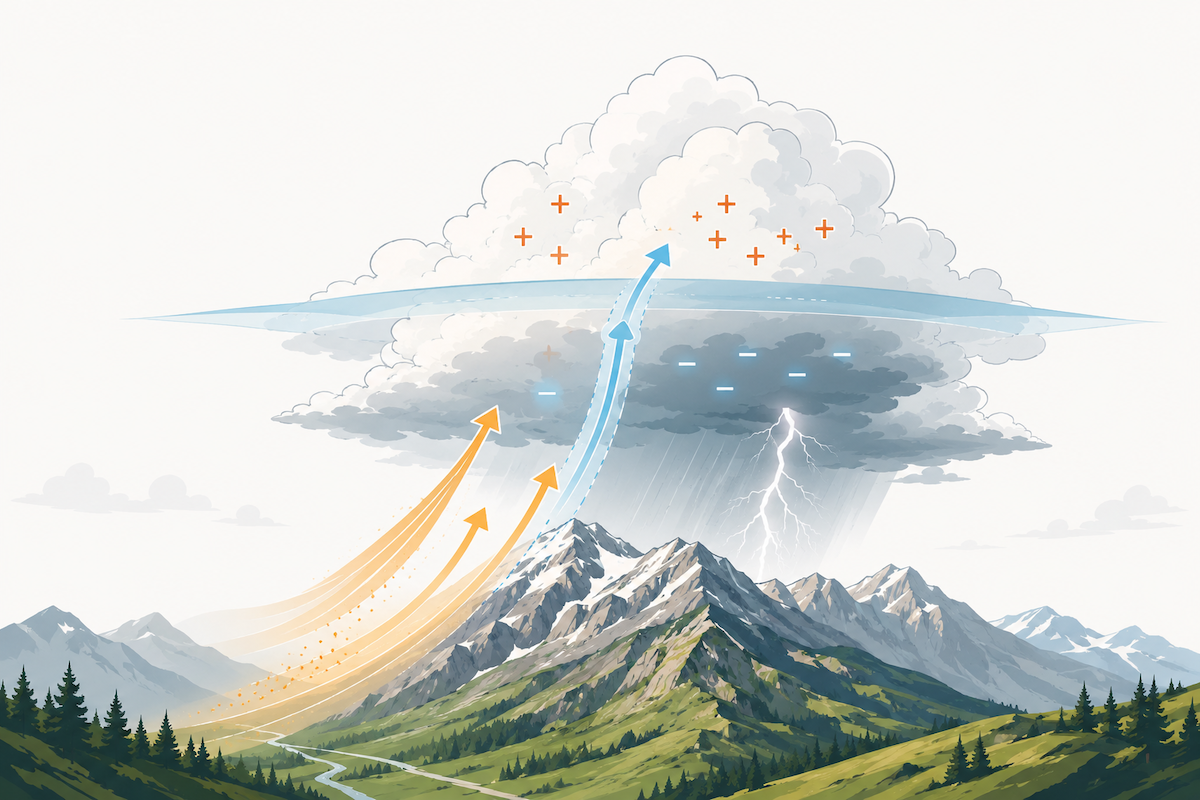
The physical story
Warm, moist air at the ground rises. As it climbs into colder heights, water vapor condenses and builds a towering cloud. Ice and water churn inside the cloud, electrical charge separates, and eventually that charge discharges as lightning.
Every ingredient below asks the same trail-planning question from a different angle: will a chunk of near-surface air rise hard and fast, and is anything stopping it?
Things must line up
Fuel, instability, and a weak enough lid need to overlap. One big number should not decide the tier by itself.
Lightning Potential is in beta and can be wrong. Do not rely on it to make go or no-go decisions. Low means no elevated model signal, not safe. If you see clouds building or storms forming, or you hear thunder, get off ridgelines and exposed terrain right away, regardless of the score.
What the product is actually showing
Lightning Potential summarizes forecast guidance. It does not detect lightning, observe storm formation, or describe conditions at every point inside a model grid cell.
Hourly signal
Every hour is scored separately
The timeline shows how the forecast setup moves through Low, Moderate, High, and Extreme. It is a setup tier, not a probability and not a report of a current storm.
Daily summary
The day shows its strongest hour
The daily label is the highest hourly tier, not an all-day average. One brief Moderate hour can make the day Moderate, so use the peak window and timeline to see whether the signal is short or sustained.
Rain forecast
Chance and amount answer different questions
The percentage is the chance of precipitation. The vertical gauge and amount show forecast depth. Rain supports the lightning read, but neither value is a lightning probability.
Details are generally most dependable in the next 48 hours. Day 3 onward is an extended outlook, where storm timing and intensity can change more as each day approaches.
The big three ingredients
TrekWeather starts with the physics that matters most: fuel, instability, and the lid. If those do not overlap, the storm signal stays limited.
CAPE
Fuel for the updraft
Convective Available Potential Energy estimates how much upward energy a rising air parcel could release. More CAPE means more fuel for stronger updrafts, but fuel alone does not make a storm.
Rough guide: under 300 J/kg is usually little fuel. 1000 to 2500 J/kg is a solid setup. 2500+ J/kg is a lot of fuel.
Lifted Index
Does the air want to rise?
Lifted Index compares a lifted surface air parcel to the air around it at about 5.5 km. If the parcel is warmer, it keeps rising. Negative numbers are the unstable ones.
The sign is the catch: -5 means very unstable, while 0 or positive is stable.
CIN
The lid on the pot
Convective Inhibition is the warm layer aloft that can stop surface air from rising. A strong lid can suppress storms even when the sky has plenty of fuel.
Small CIN means storms can trigger more easily. Large CIN means something has to punch through the cap.
Supporting signals
These do not create a severe-looking tier by themselves. They help confirm whether the broader forecast supports storm-type weather alongside the core ingredients.
Storm-type precipitation
Does the forecast support storms?
Rain chance, forecast amount, and the model’s shower field help distinguish storm-type precipitation from steadier rain.
A dry-looking model does not erase a loaded sky. Small mountain storms can be easy for a coarse model to miss.
Gusts and outflow
Possible supporting evidence
Forecast gusts arriving with rain can resemble storm outflow. Gusts happen for ordinary reasons too, so this is only a weak supporting clue.
Gusts with rain add only a small amount to the score and cannot create a top-tier result by themselves. Cloud cover is not part of the score.
Codes 95, 96, 99
The model explicitly forecasts thunder
Some forecast models emit weather codes for thunderstorm or thunderstorm with hail. These describe predicted weather for that hour, not a report of thunder at the exact location.
Coarse models rarely emit these codes, so TrekWeather treats them as support, not a requirement.
National Weather Service
A second-source thunder check
The National Blend of Models publishes an hourly thunderstorm probability. TrekWeather uses it as an independent check on the ingredient-based score.
Enough support can lift an otherwise quiet hour to Moderate. When coverage is available, a very low value can hold a would-be High or Extreme hour at Moderate.
Why alignment matters
CAPE and Lifted Index are related, but they are not the same thing. CAPE says how much total energy is available. Lifted Index says whether a lifted parcel is buoyant at a key level. CIN says whether the lid is strong enough to stop the whole process.
No elevated ingredients
The forecast is not showing enough energy or buoyancy to elevate the setup. Low still does not mean safe or storm-free.
One ingredient stands out
One side of the setup is meaningful, or the National Weather Service sees enough thunder potential to make the hour worth watching.
Ingredients overlap
Strong energy and instability overlap, the lid is not suppressing the result too far, and available National Weather Service guidance does not disagree.
Forecast ingredients max out
The strongest forecast ingredients and storm-support signals stack together. Extreme is the top forecast setup, not proof that a storm exists at every spot in the grid.
How TrekWeather turns this into a tier
Lightning Potential is a deterministic heuristic built from forecast model ingredients. TrekWeather reads its core ingredients from GFS forecast guidance, then uses the National Weather Service blend as an independent thunder check where coverage is available. The exact points can change as the beta improves, but the structure stays grounded in the same meteorology.
- Score the ingredients.CAPE and Lifted Index establish the core energy and instability signal.
- Add storm-shaped support.Rain chance, amount, convective showers, thunder codes, and possible outflow can add support without claiming a storm is currently present.
- Subtract the lid.CIN reduces the setup because a cap can stop surface air from rising.
- Cross-check the National Weather Service.Its hourly thunder probability can lift a missed hour to Moderate or hold an unsupported High or Extreme setup at Moderate. Missing coverage does not lower a tier.
- Apply the tier guardrails.Upper tiers require multiple ingredients to overlap. A loaded but dry-looking sky stays elevated because small storms can be easy for coarse models to miss.
How to use it before a hike
Compare days
Look for the lower-signal day when your itinerary is flexible, especially for exposed ridgelines, summits, and long exits above treeline.
Watch the peak window
A Moderate or High day with a clear afternoon window may still be manageable if your route is finished early. A peak window during your exposed section is different.
Respect the horizon
Treat Days 1–2 as the near-term read. Use later days to compare plans, then recheck their timing and intensity as they move inside 48 hours.
Check reality
Use official forecasts, alerts, radar, and what you can see or hear. The model is a planning layer. The sky gets the final vote.
Quick glossary
- CAPE
- Convective Available Potential Energy. Fuel for storm updrafts.
- Lifted Index
- Temperature difference showing whether a lifted air parcel is buoyant.
- CIN
- Convective Inhibition. The lid that can prevent air from rising.
- Weather codes 95, 96, 99
- Forecast weather codes for thunderstorm or thunderstorm with hail.
- National Blend of Models
- A calibrated National Weather Service forecast used as a second-source thunder check.
- Daily tier
- The strongest hourly setup forecast for that day, not an all-day average or current storm report.